
The majority of auto dealerships think that increasing leads is their greatest issue. In actuality, the true issue arises once the lead is received. According to industry data, dealerships lose about 30% of prospective clients as a result of improper handling of those leads. These prospects are not icy.
These are those who have already expressed interest by a form, phone call, message, or in-person visit to the showroom. However, because of inadequate follow-up, slow reactions, or lack of visibility, many of them silently disappear.
In today’s market, customers expect instant replies and consistent communication. If a dealership fails to respond within minutes or forgets to follow up after the first interaction, the customer moves on to another dealer. This is where a strong CRM for car dealerships becomes less of a luxury and more of a necessity.
Why do dealerships miss follow-ups even after getting quality leads?
Dealerships lose leads mainly due to missed or delayed follow ups. Yes, someone saw your email or message. And they genuinely did want to partner with you. They just forgot to respond or decided to do so later. Or maybe they just needed a bit more convincing to make a decision faster.
You will be surprised by how often phone calls and customer coordination affect sales lead closures. Online leads and service requests via WhatsApp are often overlooked during busy times. Sales executives are carried away by walk ins and paperwork. They have to handle test drives and service challenges.
With all this happening at the same time, sales executives may not recollect or manually check their client status. A timely follow up could cost a potential client. Follow-ups primarily rely on manual tracking in the absence of dealership CRM software. The lead vanishes if a sales representative is not present, quits the company, or just forgets. There isn’t a way to make sure the customer is reached again, nor is there a reminder or warning. Over time, this results in silent revenue loss and hundreds of lost opportunities.
How does scattered customer information make lead loss worse?
Several tools are still used by many dealerships to manage leads. Spreadsheets are used for follow-ups, one system for sales, another for services, and WhatsApp is used for communication. There is no one view of the customer journey when client data is dispersed across platforms.
All client information is centralised in a sophisticated automotive sales CRM. Without it, sales teams find it difficult to determine the source of the lead. They might also miss the customer’s previous inquiry and process completed. Most importantly, they might miss whether a follow-up has already been made. Customers become frustrated and turn away as a result of this uncertainty.
They don’t want to keep repeating themselves. Let alone feel like their requests are not respected or fulfilled. This frequently leads to repeated enquiries and inconsistent communication. In the worst cases, they stop and there is no answer at all.
Why is lack of lead tracking a silent revenue killer?
Inadequate lead tracking prevents dealerships from knowing which promotions are successful. They also don’t know which salesperson is performing better or where leads are disappearing. Many leads are lost for no apparent reason, remain unassigned, or are not contacted.
Only when CRM for car dealerships, which automatically logs every interaction, supports lead tracking does it become useful. Managers cannot coach their teams or enhance procedures without tracking. This results in monthly lead leakage and recurring errors.
How does losing leads affect dealership revenue and growth?
Every missed lead results in lost sales. In addition to losing revenue, a dealership wastes marketing money when it loses 30% of its leads. Spending money on campaigns, portals, and advertisements generates leads, but the investment yields no return if it is not handled properly.
Long-term client relationships are impacted by missed leads in addition to immediate revenue. If a consumer feels neglected, they are unlikely to come back for more purchases, service appointments, or recommendations. Over time, this affects customer lifetime value, brand trust, and overall dealership growth. All of which are protected by dealership CRM software.
How does a smart CRM stop lead loss at the source?
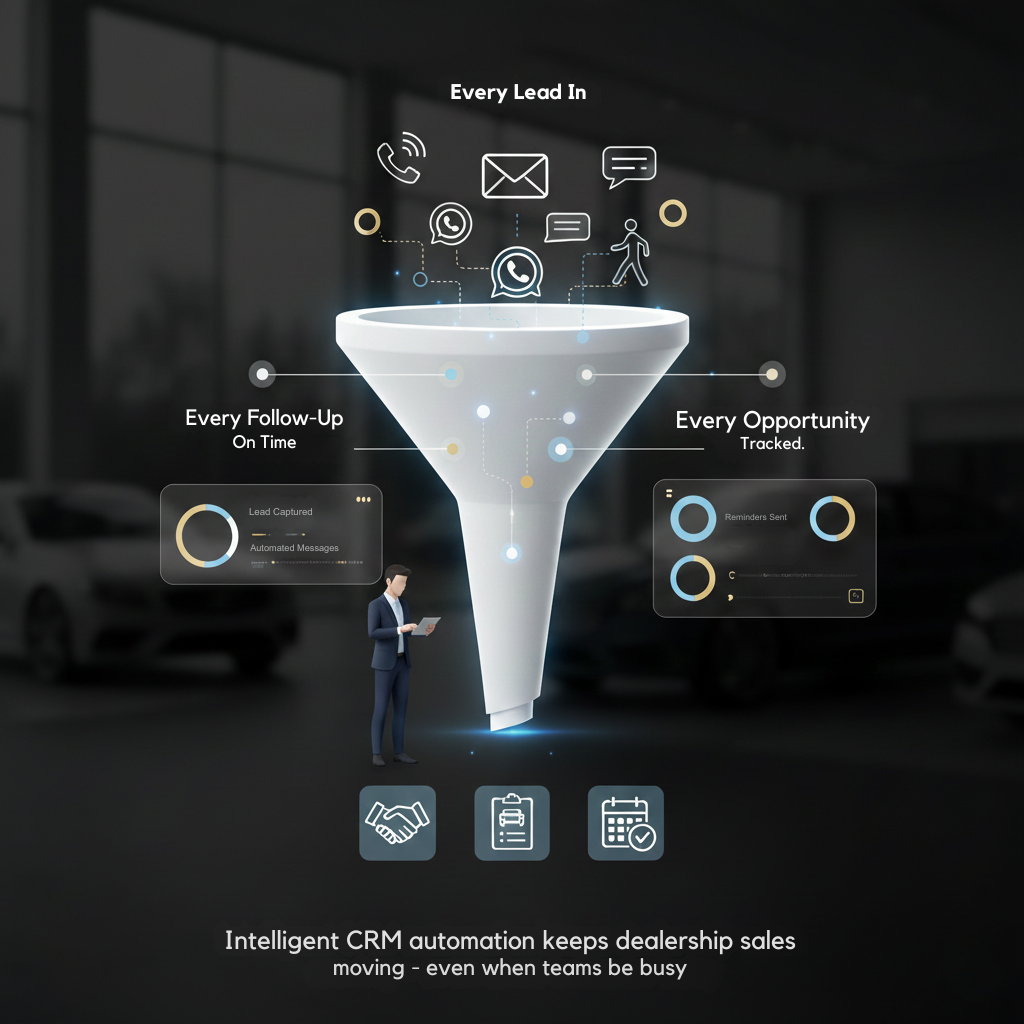
For auto dealerships, an intelligent CRM guarantees that no lead is overlooked. A lead is immediately recorded, assigned, and monitored as soon as it is received. Salespeople are certain to never forget to call, message, or email a customer thanks to follow-up reminders. Manual tracking is no longer necessary with dealership CRM software. Leads are followed up on with the appropriate context and at the appropriate time thanks to automated procedures.
Lead movement, reaction timings, and conversion phases are visible to managers. The greatest asset of a contemporary automobile sales CRM is automation. Even when sales personnel are busy or unavailable, automated communications guarantee immediate connection. Customers are kept engaged from the very first interaction because of this.
There is more confidence and clarity for executives in sales. This is because all previous conversations are visible. With this personal approach, you can build trust and faster decision cycles. This method also improves conversion rates without increasing pressure on the team.
Why is a CRM important for both sales and service departments?
The majority of dealerships neglect service leads in favour of concentrating solely on sales leads. For auto dealerships, a linked CRM guarantees that follow-ups, reminders, and service enquiries are given equal consideration. Dealerships can comprehend the entire client journey when sales and service data are integrated with dealership CRM software. By providing timely upgrades, renewals, and service packages, this contributes to a higher client lifetime value.
Dealerships experience improved follow-up discipline, quicker response times, and increased lead-to-sale conversions when they put in place a robust automotive sales CRM. Because fewer leads are discarded, marketing expenditures become more effective. Customers receive more seamless communication throughout their journey, team productivity increases, and managers are better able to understand performance.
Final Thoughts: Is your dealership ready to stop losing 30% of its leads?
Lead loss can be prevented. Car dealerships can safeguard every opportunity with the right CRM. They can also enhance customer satisfaction and increase revenue without adding to their workload. All this and more can be done simply by using the appropriate CRM. Purchasing the appropriate dealership CRM software now might convert lost leads into confirmed sales tomorrow if steady growth is important to your business.