
You drove out, measured the job, answered every question and sent a clean estimate. Then nothing. No reply to your text, no answer when you call. A week later the homeowner tells you they “went with someone else,” and you never found out why.
Most contractors do not lose these jobs on price alone. They lose them in the quiet days after the estimate goes out, when nobody follows up or the follow-up is a single “just checking in” text. This guide gives you a simple 14-day estimate follow-up sequence, ready-to-use scripts for each step, and the adjustments that matter for roofing, HVAC, plumbing, landscaping and general contracting.
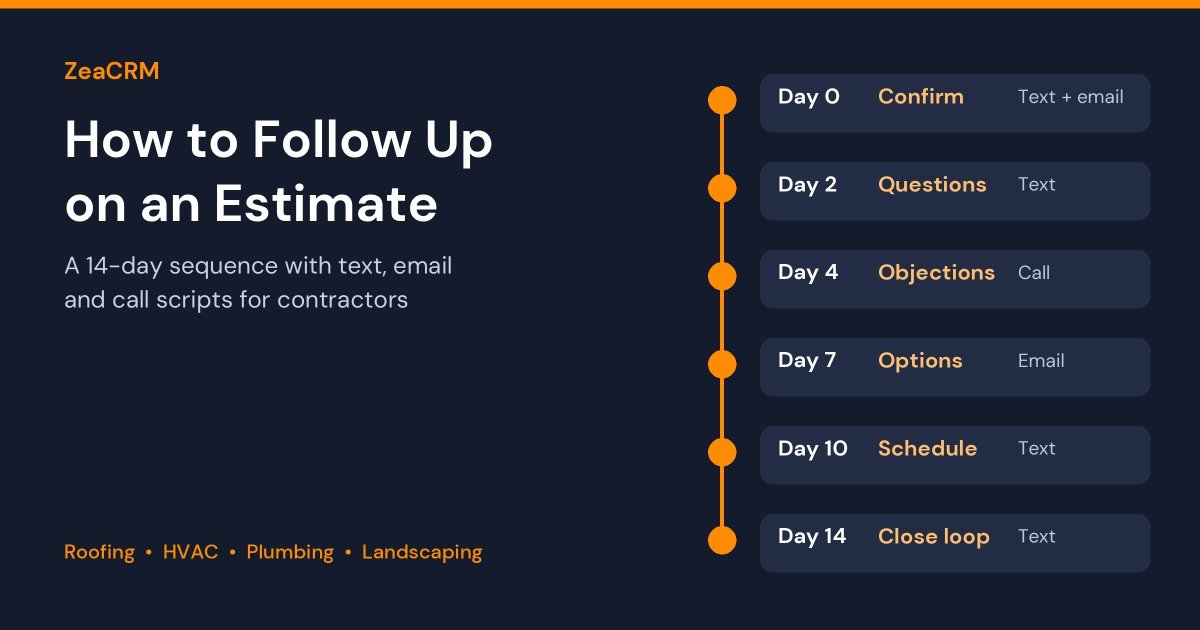
Quick answer: To follow up on an estimate, send a short confirmation the same day, check in within 24 to 48 hours to answer questions, call around day 3 to 4, send something useful (financing, photos, a scope option) around day 7, and close the loop with a polite “should I close this out?” message around day 14. Each touch should give the homeowner a reason to reply, not just remind them you exist. Use text for quick check-ins, email for detail and the phone for real objections.
Why estimate follow-up decides so many jobs
When a homeowner gets two or three estimates, they are usually comparing more than the bottom line. They are asking themselves who they trust, who explained the job best, and who will actually show up. Your follow-up is part of that comparison. A contractor who confirms the estimate, answers a question quickly and makes it easy to say yes looks like a contractor who will run the job the same way.
There is also a timing problem. Homeowners rarely decide the day they receive the estimate. They talk to a spouse, check their budget, wait for an insurance adjuster or simply get busy. If your name is not in front of them when they are ready to decide, the contractor who followed up last often wins.
The 14-day estimate follow-up sequence
This sequence works for most residential jobs. Shorten it for urgent repairs and stretch it for large projects.
| When | Channel | Goal |
|---|---|---|
| Day 0 (same day) | Text + email | Confirm the estimate arrived and set expectations |
| Day 1 to 2 | Text | Invite questions while the visit is fresh |
| Day 3 to 4 | Phone call | Find the real objection: price, timing, trust or scope |
| Day 7 | Add value: options, financing, photos of similar work | |
| Day 10 | Text | Gentle scheduling nudge |
| Day 14 | Text or email | Close the loop politely |
| After day 14 | Email (occasional) | Stay in touch for future work or seasonal needs |
Day 0: confirm the estimate
Send this within a couple of hours of the visit or of sending the estimate. It shows you are organized and gives the homeowner a direct line to you.
Text: Hi Sarah, this is Mike from Ridgeline Roofing. I just emailed your estimate for the roof replacement. It covers the tear-off, new underlayment and the architectural shingles we talked about. Any questions, text me here.
In the email, attach the estimate or proposal, summarize the scope in three or four lines, and tell them what happens next: “If you want to move forward, you can approve and sign online, and we will call to schedule.”
Day 1 to 2: invite questions
Text: Hi Sarah, Mike from Ridgeline again. Did you get a chance to look over the estimate? Happy to walk through any part of it, including the shingle options or timeline.
Keep it short and specific to their job. Mentioning a detail from the visit shows you remember them, not just their address.
Day 3 to 4: call
Texts are good for reminders. Calls are better for finding out what is actually holding the decision up. If they do not pick up, leave a short voicemail and follow it with a text.
Call script: “Hi Sarah, it’s Mike from Ridgeline Roofing. I wanted to see where you are with the roof estimate. Most people at this point are either comparing quotes, waiting on budget or insurance, or have questions about the scope. Where are you landing?”
That last question gives the homeowner easy ways to tell you the real situation. Then respond to what you hear:
- “We’re comparing quotes.” Offer to go over the differences line by line. Many quotes are not apples to apples.
- “It’s more than we expected.” Offer a scope option (phased work, a different material, repair instead of replace where it is honest to do so) or financing if you offer it.
- “We’re waiting on insurance.” Ask when the adjuster is coming and put a follow-up on your calendar for the day after.
- “Not ready yet.” Ask when would be a better time and agree on a date.
Day 7: send something useful
By now a plain reminder will not move the needle. Send something that helps the homeowner decide.
Email subject: A couple of options for your roof project
Hi Sarah, I put together two options in case it helps: the original full replacement, and a version with a different shingle line that brings the price down. I also attached photos from a similar job we finished nearby. If either works, you can approve it online, or reply and I will call you.
Day 10: scheduling nudge
Text: Hi Sarah, quick heads-up: we are booking jobs for the first week of next month. If you want to get on the schedule, I can hold a spot for you. No pressure either way.
Only mention schedule pressure if it is true. Fake urgency costs you trust.
Day 14: close the loop
The “should I close your file?” message often gets a reply when nothing else has, because it asks for a simple yes or no.
Text: Hi Sarah, I haven’t heard back on the roof estimate, so I’ll assume the timing isn’t right. Should I close it out for now, or keep it open? Either answer is fine.
If they decline, thank them and ask one question: “Mind sharing what made the difference?” The answer helps you price and present the next job better.
How to adjust the sequence by trade
| Trade | What changes |
|---|---|
| Roofing | Insurance claims slow decisions. Tie follow-ups to adjuster dates. After storms, compress the sequence because homeowners are getting several quotes at once. |
| HVAC | A no-heat or no-cool estimate needs follow-up within hours, not days. For planned replacements, follow up around rebates, financing and the shoulder season when installs are easier to schedule. |
| Plumbing | Repair estimates are often decided on the spot. Use the sequence mainly for larger work such as repiping, water heater replacement or sewer lines. |
| Landscaping | Seasonal timing matters. A spring install estimate sent in winter needs a longer, lighter sequence that restarts as the season approaches. |
| General contractors | Larger projects mean longer decision cycles and more people involved. Plan follow-ups over several weeks and offer a second walkthrough or a design meeting. |
| Smart home installation | Homeowners often need help choosing a package. Follow up with a simple good, better, best comparison. |
You can see how trade-specific workflows look on our pages for roofing, plumbing and HVAC, landscaping and general contractors.
Common estimate follow-up mistakes
- “Just checking in” with nothing new. Every message should answer a question, offer an option or ask for a decision.
- Stopping after one touch. One text is not a follow-up process.
- Following up on the wrong channel. If they texted you to book the estimate, text back. If they asked for details, email.
- Making it hard to say yes. If approving the job means printing, signing and scanning, some homeowners will stall. Online approval and e-signature remove that step.
- No record of who said what. When the office manager and the estimator both follow up, or neither does, the homeowner notices.
- Texting without the basics in place. Business texting from a regular 10-digit number needs A2P 10DLC registration with US carriers, and unregistered traffic is blocked. Only text people who have given you their number for this purpose, and honor opt-out replies such as STOP.
How to automate estimate follow-up without sounding like a robot
The sequence above is easy to describe and hard to run by hand when you have 20 open estimates and crews in the field. That is where a CRM built for trades helps.
In ZeaCRM, each estimate sits in your pipeline as a stage, so you can see at a glance which jobs are waiting on a decision. Email and SMS sequences can send the day 0, day 1 to 2, day 10 and day 14 messages automatically, while you or your office handles the day 3 to 4 call with call tracking and recording. Proposals and e-signature let homeowners approve the job online, and once the job is done, invoices and payments and review requests keep the process moving. The automation bundles come pre-built for each trade, so you do not have to design the workflow from scratch.
Two rules keep automation from feeling automated:
- Personalize the first line with something from the visit, even in a template.
- Stop the sequence the moment the homeowner replies. A real conversation always beats the next scheduled message.
If your follow-up problem starts even earlier, with calls you never got to answer, read our guide to missed-call text-back for contractors.
Frequently asked questions
How soon should a contractor follow up after sending an estimate?
Send a confirmation the same day, then a check-in within 24 to 48 hours. For urgent jobs such as a no-heat call or an active leak, follow up within hours.
How many times should I follow up on an estimate?
Five to six touches over about two weeks works for most residential jobs, as long as each one adds something new. After that, move the homeowner to occasional, low-pressure updates.
Is it better to text or call after an estimate?
Use both. Texts are best for quick confirmations and reminders. Calls are best for understanding objections and negotiating scope or timing.
What should I say when a homeowner says the estimate is too high?
Ask what they are comparing it to, walk through the scope differences, and offer an honest alternative such as a different material, a phased project or financing if you offer it. Avoid cutting price without changing scope.
How do I follow up without being pushy?
Be specific, be helpful and give the homeowner an easy out. A message like “Should I close this out or keep it open?” respects their decision and often gets a reply.
Can estimate follow-up be automated?
Yes. A CRM can send scheduled texts and emails, remind you when to call, and stop the sequence when the homeowner responds. Keep at least one personal call in the sequence.
What should I do when a homeowner goes silent after an estimate?
Send a final close-the-loop message around day 14, then add them to a light, occasional email list. Many homeowners come back months later when budget or timing changes.
Turn more estimates into booked jobs
Estimate follow-up is not about chasing people. It is about staying useful until the homeowner is ready to decide, and making it easy for them to say yes when they are. If you want a follow-up process that runs while your crews are on the job, Book a Free Demo and see how ZeaCRM handles it for your trade.